Laziness and Infinite Data
Haskell can define AllPositiveIntegers as an honest, infinite list — and find primes among them — because nothing gets computed until you actually ask to see it.
Evaluation on demand
Most languages are strict: when you write f(g(x)), g(x) is fully computed first, then handed to f. Haskell is, by default, lazy (more precisely: non-strict, using a specific technique called call-by-need): an expression is not evaluated until — and unless — its value is actually demanded, and once evaluated, the result is remembered so it’s never recomputed.
Under the hood: expressions as graphs
That last clause — “remembered so it’s never recomputed” — is worth taking apart mechanically, because it’s the entire reason call-by-need earns its name over the more wasteful call-by-name (recompute every time, remember nothing).
A Haskell expression isn’t stored as flat text; GHC represents it as a graph — boxes for function applications, arrows pointing to their arguments. Any part of that graph matching the left-hand side of some function’s definition is a redex (“reducible expression”): a piece ready to be rewritten according to that function’s rule.
square :: Int -> Int
square x = x * x

ghci> square (1 + 2)
9
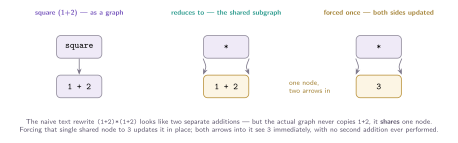
Figure: square’s rule doesn’t copy its argument for each occurrence of x in x * x — it shares one node, pointed to twice. Forcing that single shared node to 3 updates it in place; both arrows into it see 3 immediately, and the addition 1 + 2 never happens a second time.
This is precisely what separates lazy evaluation from naively rewriting text. A purely textual substitution of square (1+2) into (1+2) * (1+2) really would compute 1 + 2 twice — once per occurrence. The graph never makes that mistake: x is one node in memory, referenced from two places, and reducing it once is visible from both references at once. This sharing is exactly what “the result is remembered” meant a paragraph ago — not a special case, but the graph’s ordinary behavior.
Lazy evaluation always reduces the topmost redex first, which is what makes short-circuiting fall out for free rather than needing special-case handling. (&&)’s own definition, True && x = x and False && x = False, means ('H' == 'i') && ('a' == 'm') reduces its first argument just far enough to see False, matches the second equation, and produces False immediately — the second comparison, 'a' == 'm', is never touched, not because Haskell has a special rule for && the way some languages hard-code short-circuiting, but because that’s what “reduce the topmost redex, and only evaluate arguments as far as pattern-matching demands” always does.
This is easiest to see by trying to break it:
ghci> let x = 1 `div` 0        -- division by zero — normally an error
ghci> let pair = (x, "hello")  -- no error yet: x was never DEMANDED
ghci> snd pair
"hello"                        -- still no error — we only ever asked for snd
The div by zero never happens, because nothing ever forced fst pair to be evaluated. In a strict language this program would crash immediately; in Haskell it runs fine, because a binding is a promise to compute a value if asked, not a command to compute it now.
The all-important consequence: infinite lists are just… lists
Because nothing is computed until demanded, there’s no rule against defining a list with infinitely many elements. It only becomes a problem if you ask for all of it at once.
allPositiveIntegers :: [Integer]
allPositiveIntegers = [1..]
-- equivalently: allPositiveIntegers = 1 : map (+1) allPositiveIntegers
That commented-out equivalent is worth pausing on, because it’s not just a list that happens to be long — it’s a list whose own definition refers to itself. The very purest version of that idea is a value like ones = 1 : ones, which as a graph looks genuinely different from any finite list:
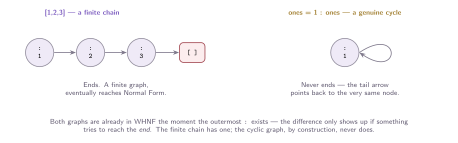
Figure: A finite list’s graph is a chain that ends. ones = 1 : ones draws a genuine cycle instead — the tail arrow points back to the very same cons cell, not to a copy of it. Both are already in WHNF the instant the outermost : exists; the difference only shows up if something ever tries to walk all the way to the end.
allPositiveIntegers’s own self-reference is a close cousin of this, not an identical shape — each step builds a genuinely new cons cell via map (+1) rather than looping back to one single node — but the underlying reason it’s possible at all is the same one ones’s literal cycle makes vivid: a definition is allowed to mention itself, because nothing is forced to “finish” before the definition is accepted as valid. take 5 allPositiveIntegers walks five such steps and stops; only a function that genuinely demands an end, like length, would run forever.
ghci> take 5 allPositiveIntegers
[1,2,3,4,5]
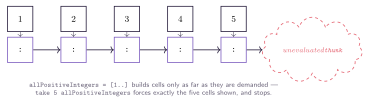
Figure: allPositiveIntegers = [1..] really is infinite — but take 5 only ever forces the first five cons cells into existence. Everything past that stays an unevaluated thunk: a suspended computation, sitting there unbuilt, until (and unless) something asks for it.
allPositiveIntegers is a completely ordinary value of type [Integer] — you can pass it to other functions, pattern-match on it, zip it with something else — and none of that forces the whole (impossible) infinite list to be built. Only functions that genuinely need to see “everything,” like length or sum, would loop forever on it, because they demand an answer that doesn’t exist.
Laziness doesn’t mean “slow” and it doesn’t mean “eventually gets around to it” — every value is still computed exactly when something needs it, immediately. The word describes when work happens (on demand, rather than eagerly ahead of time), not how fast. This is a genuinely common point of confusion for people coming from “lazy” used as a synonym for “sluggish” in everyday English.
Building the primes, honestly
The classic showpiece of laziness is defining the infinite list of prime numbers as a value — not a function you call with a bound, an actual list, exactly the way a mathematician would write :
primes :: [Integer]
primes = sieve [2..]
  where
    sieve (p:xs) = p : sieve [x | x <- xs, x `mod` p /= 0]

ghci> take 10 primes
[2,3,5,7,11,13,17,19,23,29]

ghci> takeWhile (< 100) primes
[2,3,5,7,11,13,17,19,23,29,31,37,41,43,47,53,59,61,67,71,73,79,83,89,97]
Read sieve the way a mathematician reads the Sieve of Eratosthenes: take the head of the remaining candidates as prime, then filter every multiple of it out of the rest, and recurse — on a list that, itself, never ends. Each recursive call to sieve demands only as many elements of its input as the next caller demands from it, all the way back up to whatever take 10 or takeWhile asked for at the top. Nothing about this definition mentions a stopping point, because it doesn’t need one — the caller decides how much of “forever” it actually wants to look at.
This particular sieve is elegant but not the asymptotically fastest prime sieve — the nested mod checks against every previously found prime add up. It’s kept here in its classic, textbook form because the point isn’t performance, it’s that “the infinite list of primes” is expressible, directly, as ordinary Haskell with no special machinery. (A proper Sieve of Eratosthenes with early termination and unboxed arrays is one of the standard “now make it fast” exercises once this version clicks.)
Laziness enables modularity
Beyond the “wow, infinite lists” party trick, laziness has a quieter, arguably more important benefit: it lets you separate generating data from consuming it, without paying for values you never look at.
firstPrimeOver1000 :: Integer
firstPrimeOver1000 = head (dropWhile (<= 1000) primes)
In a strict language, you’d typically have to write a single fused loop — “generate primes and stop once you find one over 1000” — mixing two concerns together for efficiency’s sake. In Haskell, primes (the generator) and dropWhile (<= 1000) (the consumer) are written completely independently, each as simple and general as possible, and laziness fuses them automatically at runtime: only as many primes get generated as dropWhile and head actually end up demanding.
This “generate the whole (possibly infinite) space, then let the consumer decide how much to look at” pattern shows up constantly outside Haskell too — Python generators and itertools, Java 8 Streams, and reactive programming libraries like RxJava are all, in effect, retrofitting a limited, opt-in version of laziness onto languages that are strict by default. Haskell is unusual mainly in making this the default way every value behaves, rather than a special API you reach for.
The tradeoff, briefly
Laziness isn’t free. Building up long chains of unevaluated thunks instead of computing values immediately can, in pathological cases, use more memory than strict evaluation would — a phenomenon Haskell programmers call a “space leak.” Functions like foldl' (the strict variant of foldl) exist specifically to opt back into eager evaluation where it matters.
Thunks, WHNF, and Normal Form
“Unevaluated” has been doing a lot of work in this chapter without ever being pinned down precisely — it’s worth stopping to name the pieces properly, since the next section’s tools (seq, foldl', bang patterns) only make sense once “how evaluated is this?” has real, distinct answers.
A thunk is exactly what a lazy binding actually is underneath: not a value, but a suspended computation — the code needed to produce a value, paired with the environment it needs to run in, sitting in memory doing nothing until something asks for it. let x = 1 + 2 doesn’t compute 3; it builds a thunk that would compute 3, the moment anything forces x. Forcing a thunk runs its code exactly once and then permanently overwrites the thunk with the resulting value — a second demand for x reuses that stored answer rather than recomputing it, which is what makes laziness in Haskell “call-by-need” rather than the more wasteful “call-by-name.”
Once something does force a thunk, there are two genuinely different stopping points, not one:
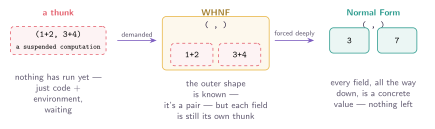
Figure: The same value, (1+2, 3+4), at three depths of evaluation. WHNF only confirms the shape — here, “it’s a pair” — without looking inside either field. Normal Form keeps going until literally nothing anywhere in the structure is still a thunk.
Weak Head Normal Form (WHNF) stops at the outermost constructor (or lambda) and goes no further. Forcing (1+2, 3+4) to WHNF confirms only that the value is a pair — (,) — full stop; the two expressions inside, 1+2 and 3+4, are left exactly as unevaluated as they started.
Normal Form (NF) means genuinely finished: no thunks anywhere, at any depth, in the whole structure. (3, 7) is in Normal Form; (1+2, 3+4) reduced only to WHNF is not, even though both “look like a pair” from the outside.
Every value in Normal Form is automatically also in WHNF — full evaluation trivially satisfies “the outer constructor is known” — but the reverse almost never holds. This asymmetry is exactly why so many space leaks survive a seemingly-correct fix: reaching some form of “evaluated” (WHNF) feels like it should be enough, but for anything with more than one field, it usually isn’t.
Controlling evaluation: seq, WHNF, and the tuple trap
The tool for opting back into strictness is seq:
seq :: a -> b -> b
a `seq` b evaluates a to WHNF — exactly the shallow notion just defined above — and then returns b. For Just (1+2), that means only confirming the value is Just something; the 1+2 inside stays an unevaluated thunk until something forces it specifically.
-- lazy accumulator: builds a chain of thunks, (((0+1)+2)+3)+..., unevaluated
sumLazy :: [Int] -> Int
sumLazy = go 0
  where go acc []     = acc
        go acc (x:xs) = go (acc + x) xs   -- acc + x is NOT forced here!

-- strict accumulator: forces each intermediate sum immediately
sumStrict :: [Int] -> Int
sumStrict = go 0
  where go acc []     = acc
        go acc (x:xs) = let acc' = acc + x
                          in acc' `seq` go acc' xs
sumLazy on a long list builds an enormous, deeply nested chain of unevaluated additions before ever computing anything, risking a stack overflow when that chain is finally forced. sumStrict forces each partial sum immediately with seq, keeping memory use constant. In practice, Data.List’s foldl' does exactly this pattern for you.
seq a b forces a to WHNF — it does not force a completely (“deep” evaluation). seq (Just undefined) 5 still safely returns 5, because reaching WHNF only inspects the Just constructor, never the undefined hiding inside it. Confusing WHNF with full evaluation is a common source of “I added seq and the leak is still there” bug reports; the deepseq package’s force function is the tool for genuinely forcing an entire structure.
Here’s where that shallowness has real teeth: foldl' looks like it should end the space-leak problem for good — and for an accumulator like a bare Int, it does. But the moment the accumulator has more than one field, WHNF’s shallowness bites back.
import Data.List (foldl')

sumAndLength :: Num a => [a] -> (a, Int)
sumAndLength xs = foldl' step (0, 0) xs
  where step (total, count) x = (total + x, count + 1)
This looks strict — it uses foldl', after all — but it still leaks. foldl' forces the accumulator to WHNF at each step, and for a pair, WHNF means only the outer (,) constructor: the tuple itself is forced, but its two fields, total + x and count + 1, are left as unevaluated thunks, exactly as before. Run this over a few million elements and both fields grow an enormous chain of unreduced additions, defeating the entire point of using foldl' in the first place.
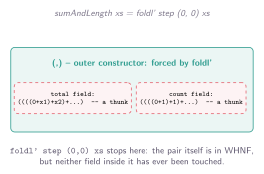
Figure: foldl' forces the tuple’s outer constructor at every step (solid outline) — but the two thunks living inside it (dashed) are never touched, and keep growing regardless.
The fix is to make the fields themselves strict, not just the tuple that holds them — either with bang patterns in the step function, or, more robustly, with a dedicated strict data type:
-- fix 1: force both fields explicitly, every step
sumAndLength' :: Num a => [a] -> (a, Int)
sumAndLength' xs = foldl' step (0, 0) xs
  where step (!total, !count) x = (total + x, count + 1)

-- fix 2: a genuinely strict pair type -- can never hold an unevaluated field
data Pair a b = Pair !a !b

sumAndLength'' :: Num a => [a] -> (a, Int)
sumAndLength'' xs = done (foldl' step (Pair 0 0) xs)
  where step (Pair total count) x = Pair (total + x) (count + 1)
        done (Pair total count)  = (total, count)
Both work; they differ in how easy they are to get wrong. The bang patterns in sumAndLength' only help at the pattern match in step — forget to bang a field in some other function that also touches this accumulator, and the leak is back. Pair’s bangs are part of the type itself (!a, !b in the data declaration from Base Camp): every value of type Pair a b, wherever it’s constructed, is guaranteed to have both fields already in WHNF, with no way to accidentally construct a lazy one.
This exact gotcha — foldl' plus a lazy tuple accumulator — is common enough in real Haskell codebases that it has its own name in the community: the “tuple trap.” It’s precisely why performance-sensitive libraries almost never accumulate into plain tuples; the foldl package on Hackage exists in large part to package up the strict-accumulator pattern shown here so nobody has to hand-roll a Pair type for every fold.
Later chapters take laziness as a given rather than dwelling on this further, but it’s worth knowing upfront: “lazy by default, strict when you ask for it” is the actual bargain, not “lazy, full stop” — and “strict” needs to reach all the way down to every field that matters, not just the outermost layer.