Back to the Calculus: Encodings, Recursion, and Why Laziness Works
Chapter 2 kept the lambda calculus practical — just enough to explain currying and point-free style. Now that laziness, purity, and Functors have all had their turn, it's worth returning to that same tiny system and seeing the rest of what it can do: encode its own data, recurse with no names at all, and explain, with an actual theorem, why Haskell chose to be lazy in the first place.
Chapter 2 introduced the lambda calculus just far enough to explain currying, beta reduction, and point-free style — the load-bearing pieces every later chapter would lean on immediately. That same tiny system, three rules and nothing else, turns out to have quite a bit more up its sleeve. With laziness (Chapter 6), purity (Chapter 7), and Functors (Chapter 9) all now familiar, three more of its consequences are worth a proper look — including one that finally explains, with an actual theorem rather than a design preference, why Haskell is lazy at all.
Reduction order: why laziness isn’t arbitrary
Beta reduction says what substitution to perform. It says nothing about which redex to reduce first when a term contains more than one — and that choice, it turns out, isn’t just an implementation detail. It can be the difference between a program that finishes and one that never does.
Consider (\x -> 5) loop, where loop = (\x -> x x)(\x -> x x) — a term, sometimes called Ω (omega), that reduces to itself forever and never reaches a normal form:
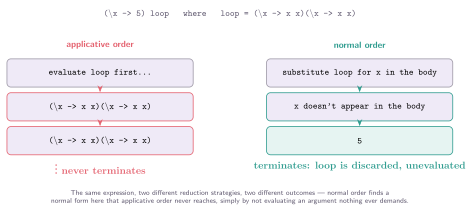
Figure: The same expression, two different reduction strategies, two different outcomes — normal order finds a normal form here that applicative order never reaches, simply by not evaluating an argument nothing ever demands.
Applicative order — reduce the argument before substituting it in, the strategy nearly every mainstream language uses by default — tries to evaluate loop first, since it’s the argument being passed. But loop never reduces to anything simpler; applicative order on this term runs forever, without ever reaching (\x -> 5) loop’s actual answer.
Normal order — substitute the argument in unevaluated, and only reduce it if the body actually uses it — never touches loop at all. x doesn’t appear anywhere in the body 5, so the substitution simply discards loop, unexamined, and the whole term reduces immediately to 5.
This isn’t a cherry-picked curiosity — it’s a theorem. The Church-Rosser theorem guarantees that if a lambda term has a normal form at all, normal order reduction will always find it, eventually. Applicative order carries no such guarantee: it can loop forever on a term that genuinely does have a perfectly good answer, exactly as (\x -> 5) loop demonstrates.
This is the actual mathematical justification behind a decision this book asked you to simply accept back in Chapter 6: Haskell’s laziness is normal order reduction (more precisely, call-by-need — normal order plus sharing, so a substituted argument is only ever evaluated once even if used many times), chosen specifically because it terminates in strictly more cases than the eager, applicative-order evaluation most languages default to. Every example in the Laziness chapter — primes, infinite lists, undefined values that never cause a crash because nothing forces them — is this exact theorem, doing real work, twenty-some chapters before it got a name.
Normal order’s termination guarantee is a strict improvement, not a free lunch — reducing arguments lazily rather than eagerly means an argument used many times can, without care, be re-evaluated many times over, or (Chapter 6’s whole “tradeoff, briefly” section) build up a long chain of unevaluated thunks instead of a value. Call-by-need’s sharing closes the repeated-evaluation gap specifically; it does nothing to prevent the thunk-buildup half of the tradeoff on its own.
Building data out of nothing but functions
Since the calculus has no built-in booleans or numbers, an early and genuinely beautiful discovery was that you don’t need them — you can encode data as functions that behave the right way when applied. This is called Church encoding.
-- Booleans: TRUE picks its first argument, FALSE picks its second
true'  = \t -> \f -> t
false' = \t -> \f -> f

-- "if" is just application: no special syntax needed at all
if' = \b -> \t -> \f -> b t f

if' true' "yes" "no"   -- reduces, by substitution alone, to "yes"
true' and false' aren’t labeled as booleans anywhere — they’re just functions that happen to select one of two arguments. if' doesn’t need to “look inside” a boolean and branch on it; it just applies the boolean to the two branches and lets beta reduction do the choosing. The entire behaviour of if falls straight out of function application, with nothing extra added.
Numbers work the same way. A Church numeral for is a function that applies whatever it’s given, times:
zero'  = \f -> \x -> x                    -- apply f, zero times
one'   = \f -> \x -> f x                  -- apply f, once
two'   = \f -> \x -> f (f x)              -- apply f, twice
succ'  = \n -> \f -> \x -> f (n f x)      -- one more application than n
two' (+1) 0 reduces, by nothing but substitution, to (+1) ((+1) 0) = 2 — the numeral genuinely computes its own value, out of raw function application, with no numbers involved in its own definition.
The same trick extends to pairs — Base Camp’s tuples — with no new machinery at all, just the exact “pick one of two things” shape true'/false' already used above:
pair' = \x -> \y -> \f -> f x y     -- store x and y, wait for a selector

fst' = \p -> p (\x -> \y -> x)      -- select the first, using true's own shape
snd' = \p -> p (\x -> \y -> y)      -- select the second, using false's own shape

fst' (pair' 3 4)   -- reduces, by substitution alone, to 3
snd' (pair' 3 4)   -- reduces, by substitution alone, to 4
pair' 3 4 doesn’t build a “box” containing two values anywhere in memory — it builds a function waiting for a selector, and fst'/snd' are just true'/false' wearing two-argument clothes. A pair, a boolean, and a number all turn out to be the identical idea underneath: a function shaped to make exactly one specific choice, however that choice gets used.
Church encodings aren’t just a historical curiosity. Alonzo Church originally used a slightly different, subtly broken numeral encoding in his first attempt; it was his student Stephen Kleene who found the fix that made arithmetic on Church numerals actually work, while famously realizing it during a visit to the dentist. Kleene went on to do foundational work connecting computability to logic that still underlies modern type theory.
Recursion without a name: the Y combinator
There’s a puzzle hiding in all of this: the lambda calculus has no let rec, no way for a function to refer to itself by name — every term is anonymous. So how do you write something like factorial, which obviously needs to call itself?
The startling answer is a fixed-point combinator — a function that, given any function f, produces f’s fixed point: a value x such that f x = x. The classic one is the Y combinator:
-- Y = λf. (λx. f (x x)) (λx. f (x x))
y' f = (\x -> f (x x)) (\x -> f (x x))
Applying Y to a function f produces a value that, when unfolded by beta reduction, keeps handing f a copy of “the rest of the computation” to call whenever it needs to recurse — self-reference achieved with nothing but application and substitution, no naming required at all.
GHC’s own Data.Function.fix :: (a -> a) -> a is a typed, well-behaved cousin of exactly this combinator, and it’s what Haskell’s let x = f x in x-style self-referential bindings compile down to underneath. Chapter 5 described a Haskell binding as “an equation, true forever” — fix f = f (fix f) is that idea taken to its logical extreme: a definition that refers to itself, and is simply true, resolved lazily one unfolding at a time rather than computed all at once.
fix shows up in real code more often than its reputation as a theoretical curiosity suggests — it’s a clean way to write mutually-recursive-looking definitions without a separate helper function, and library authors occasionally use it to build a memoizing recursive structure (a data structure that refers to itself the way fibs = 0 : 1 : zipWith (+) fibs (tail fibs) does) without hand-writing the self-reference each time.
The Lambda Papers: what lambda turned out to be able to do
The Y combinator above is a good place to pause and mention the actual research program that pushed the untyped calculus this far in the first place. Between 1975 and 1980, Guy Steele and Gerald Sussman — then at MIT, building the Scheme dialect of Lisp — wrote a sequence of papers now known simply as the Lambda Papers, each one pushing on a different consequence of taking lambda completely seriously as the only primitive a language needs.
“Scheme: An Interpreter for Extended Lambda Calculus” (1975) is where Scheme itself first appears — a Lisp dialect built directly around lambda, with lexical scoping (Chapter 2’s alpha-conversion hygiene, taken as a design commitment rather than a footnote) as one of its first and most consequential choices.
“Lambda: The Ultimate Imperative” (1976) is the most famous of the series, and the boldest claim: every common imperative construct — recursion, iteration, GOTO and assignment, continuation-passing, exception-style escapes, even different argument-passing conventions like call-by-name and call-by-reference — can be modeled using nothing but lambda application, conditionals, and (rarely) assignment. No stacks, no special control-flow machinery baked into the language; just functions calling functions. This is Chapter 2’s “no such thing as a two-argument function, only functions returning functions” idea, pushed until it swallows an entire language’s control flow.
“Lambda: The Ultimate Declarative” (1976) takes a different angle on the same primitive: lambda reinterpreted as a renaming operator rather than the usual “function” reading — a more structural, less operational way of understanding what a lambda abstraction actually does to the names inside it.
“Lambda: The Ultimate GOTO” (1977, formally titled “Debunking the ‘Expensive Procedure Call’ Myth”) tackles a specific piece of programming folklore head-on: the assumption that procedure calls are inherently more expensive than a raw jump. Steele showed that a tail call — a procedure call that is the very last thing a function does — can be compiled exactly as cheaply as a GOTO, with no growing stack at all. This is not a minor implementation detail: it is the direct reason Scheme became the first language to require tail-call optimization as part of its specification, and it is why the “recursion instead of loops” style this book has used constantly since Base Camp is not, in a properly tail-call-optimized implementation, actually more expensive than an explicit loop would have been.
The series takes its name from exactly this repeated framing — “Lambda: The Ultimate X,” for whatever imperative feature X was being dissolved back into lambda application that particular paper. The influential programming-languages discussion site Lambda the Ultimate borrowed its own name directly from this running joke, decades later.
Three consequences, one tiny system: data with no primitives beyond functions, recursion with no names, and a theorem explaining why an entire language chose laziness as its default. Chapter 2 asked you to take the calculus’s practical payoffs on faith; this chapter is the rest of what that same system was quietly capable of the whole time.